
Meriden City Directory Shelf
Meriden Public Library's Meriden Room owns the strongest continuous run of local volumes, reaching from 1868 through 1992. Few collections match it. Each book lists residents, streets, and businesses, so one lookup can carry a name to an address and onward to a nearby shop or organization. The 1868 date marks the first confirmed year in that run. No earlier directory is ruled out, though. A complete publisher list remains unbuilt. The table keeps confirmed holdings apart from the better-known Price & Lee editions and from a reverse-directory question that still waits on a librarian's answer. Ask before assuming.
| Collection | Years | Publisher or form | Where held | Access |
|---|---|---|---|---|
| Meriden City Directories | 1868-1992 | Publisher varies; full matrix not established | Meriden Public Library Meriden Room | Appointment; residents, streets, businesses |
| Price & Lee Meriden editions | 1881, 1886, 1887 | Price & Lee Company | Google Books and the library run | Digitized OCR or scan; inspect the page |
| Meriden directory bibliography | 1909 description | Price & Lee Co. | ProQuest description and library holdings | 452 pages, folded map, indexes, sections |
| Street and resident sections | Within the confirmed run | Bound directory sections | Meriden Room | Street, resident, and business cross-check |
| Separate criss-cross run | Dedicated years not established | Not documented | Ask the Meriden Room | Street sections are confirmed; do not assume a separate set |
Record the gaps instead of guessing them. War-year suspensions, a final publisher change, and a separate phone-book run all remain unestablished. Volumes do not circulate. A missing name can mean a skipped year. It can also mean a spelling change, a move, or a plain omission.
Meriden Public Library's History and Genealogy page names the local-history desk. It also lists the directory, newspaper, map, and database resources there.
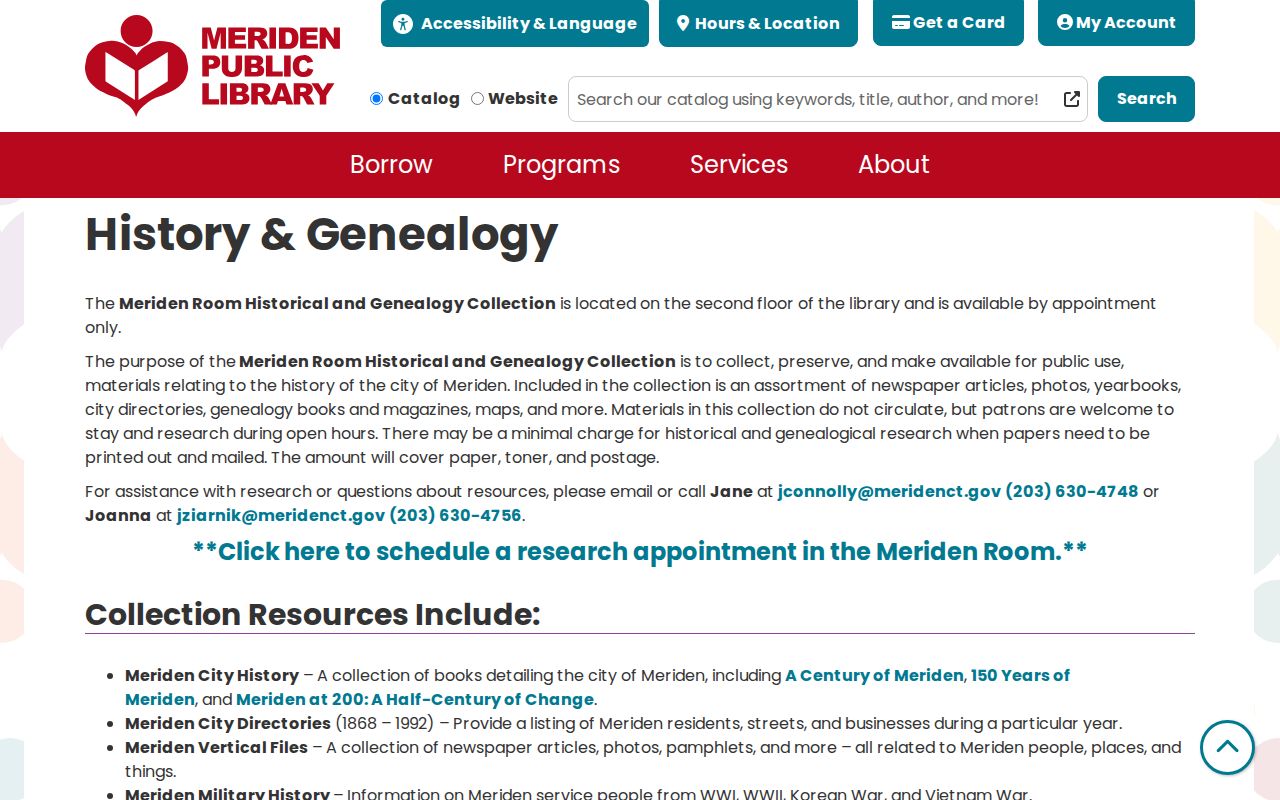
The library source joins the printed run with staff contacts and on-site research rules.
The 1887 Meriden City Directory
Price, Lee & Co.'s 1887 volume is the clearest digitized Meriden directory. Google Books credits Columbia University as the original source. Its digitization date is January 26, 2017. The contents open with Abbreviations on page 4, Blocks Buildings etc on page 16, and the Business Directory on page 213. One person can appear in four different sections.
Other years sit unevenly. Google Books shows 1886 in snippet view and 1881 with no preview at all. The 1909 bibliography describes a 452-page Price & Lee volume with a folded map plus citizen, business, street, officer, church, and society sections. Compare title pages before trusting any year-to-year match.
The digitized Price & Lee 1887 record is where the OCR and bibliographic trail begins.
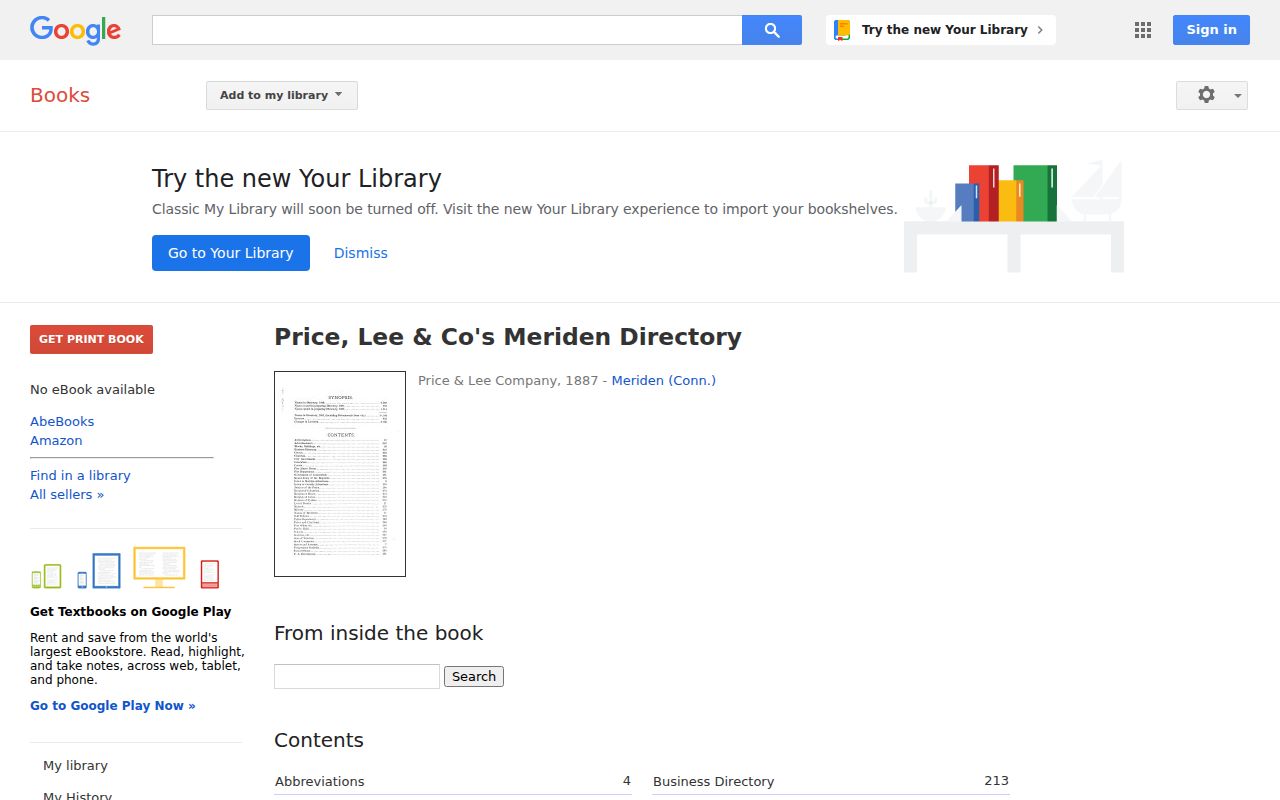
OCR points to a page, not a full line.
Reading a Meriden Directory Entry
The 1887 OCR supplies real entry samples. A search for Horace T. returns PA185: “SMITH HORACE T., city express and jobber State Camp, h 92 Camp - See p 342.” M. B. C. Co. returns PA106 with “Robert L., emp M. B. C. Co., h 900 Broad.” PA28 adds another employer and a boarding fragment. Check the page image before quoting anything more.
| Person line | SMITH HORACE T., with a given name, middle initial, occupation, employer wording, and a home-style address. |
|---|---|
| Occupation clue | “city express and jobber” is a historical description, not present identity proof. |
| Employer mark | “emp M. B. C. Co.” needs the volume's key or local context. |
| Residence mark | “h 92 Camp” and “h 900 Broad” show the home-style address shorthand visible in the snippets. |
| Boarding clue | “bds” appears in the OCR inventory as a boarding or rooming marker; it is not a title or ownership mark. |
| Cross-reference | “See p 342” sends the reader to another page for fuller context. |
| Owner or renter mark | No owner or renter symbol is established in the inspected sample. An address, “h,” or “bds” entry does not prove title. |
- Criss-cross directory
- An address-first list from a street or number to a listed occupant. Meriden street sections are confirmed, but a separate run and its years are not established.
- Householder index
- A name-centered aid for a head of household or listed resident. It points to a page without making every household member a separate entry.
- Abbreviation key
- The volume's explanation of short forms and symbols. In 1887 it begins on page 4; use it before reading “emp,” “h,” “widow,” “blk,” initials, or “See.”
Trace a Meriden Directory Household
Don't trust a single name hit. Move between the resident and street sections. Keep spelling, address, occupation, company initials, spouse or widow notation, and nearby street terms together, since a surname can appear more than once.
- Record the target name, middle initial, street spelling, number, and likely year. Photograph the title page and abbreviation key for each volume.
- Search the surname in the general resident section. Note every matching given name, occupation, employer abbreviation, spouse or widow notation, and page cross-reference.
- Turn to the street section and test the same number, nearby numbers, and older spelling. A street entry can reveal the person who was listed at the address even when the general entry is hard to read.
- Compare adjacent directory years, then pair the nearest directory with a federal census image from the 1790-1930 library run. The census adds age, relationship, and household structure for its enumeration year, while the directory fills annual gaps.
- Use Meriden newspaper film, vertical files, the Barbour index, Hale inscriptions, or a yearbook to test a move, death, school connection, or company clue. For a title-first address trail, the Meriden past-resident workflow starts with the parcel and deed chain instead.
A disappearance has many explanations. Moves and deaths explain many gaps. A changed surname, an omission, or a town line can also hide a household, and later obituaries, census pages, maps, or deeds may narrow it, since no directory is a complete register.
Meriden Directory Room Access
The Meriden Room sits on the second floor of the Meriden Public Library at 105 Miller Street. Visits are by appointment, and nothing in the room circulates. Hours run Monday 9:30-5, Tuesday through Thursday 9:30-8:30, Friday and Saturday 9:30-5, with Sunday closed. For scheduling, call 203-630-4730.
Two staff members handle Meriden Room questions. Jane Connolly, jconnolly@meridenct.gov, 203-630-4748, and Joanna Ziarnik, jziarnik@meridenct.gov, 203-630-4756, are the listed contacts. Copies cost only paper, toner, and postage. Ancestry Library Edition and Newspapers.com work on library computers alone, so ask about the year range and microfilm time when you book.
Meriden Public Library
105 Miller Street
203-630-4730
Appointment-only Meriden Room with directories, microfilm, vertical files, maps, yearbooks, and library-only databases.
Meriden Room Contacts
Jane Connolly
203-630-4748
Joanna Ziarnik
203-630-4756
Ask for volume, section, year, and copy method.
Meriden Newspapers and Companion Records
Directories answer where; other records answer why and what else. Meriden newspapers survive on microfilm from 1863-2020, and the library's Newspapers.com description reaches back to 1868. Vertical files hold articles, photos, and pamphlets. For earlier vital events, Barbour indexes Meriden statistics for 1806-1853, while Hale headstone inscriptions fill 1934 volumes 26-27. Neither index replaces the underlying record it points to.
Sanborn maps span 1884-1950, and census microfilm covers 1790-1930. Each has limits. Sanborn shows structures, not guaranteed occupants; the census captures one household on its enumeration date, not a full address history. Obituaries, cemetery clues, and probate files can bridge the gaps between directory years.
Connecticut History's Meriden town collection pulls local books, maps, and historical context into the same research path.

A Meriden residents directory entry pairs neatly with a map or town-history source. That pairing pins down an old address before you chase the parcel.
Meriden Yearbooks Add Names
Yearbooks separate people who share a name. The documented runs cover Meriden High from 1953-1958, Maloney and Platt from 1959-2020, and Wilcox Technical from 1954-2020. The Historical Society keeps hard copies. The Connecticut Digital Archive holds linked material online. A class year, photo, activity, or school can test a directory match.
Use the yearbook beside the printed volume: a directory gives a street clue, a yearbook a class connection, a newspaper a move or an obituary. Record the school, year, page, and spelling. Wanda Guzman (wguzman@meridenct.gov) is the listed library contact; ask whether an item is digitized through the Connecticut Digital Archive.
Meriden Historical Society Directories
The Meriden Historical Society keeps its Museum & History Center at 41 West Main Street. The address is Meriden, Connecticut 06451. Research happens by appointment or written request. Reach the curators at ResearchRequest@MeridenHistSoc.org, by phone at 203-639-1913, or through PO Box 3005. A good request lists name variants, a street or building, and rough years. It also states the record question. Please include a stamped self-addressed envelope.
On the shelves sit books, pamphlets, maps, catalogs, ledgers, directories, yearbooks, and International Silver material. Cataloging of the library is ongoing, so no lookup is guaranteed. Curators can sometimes answer occupant or industry questions. An open index or private roster may not exist for every request, though. The Historical Society contact and research page shows the current appointment route. It also steers researchers away from the Society's former Morehouse Research Center address.
The Society route covers material that may not appear in a web search.
A Meriden City Directory Timeline
Two dates anchor any Meriden city directory timeline. The town date is 1806; the city date is 1867. The library's confirmed run begins with an 1868 volume, and Price & Lee references supply later publication landmarks for tracing the series decade by decade.
| Year or span | Documented event | Why it matters |
|---|---|---|
| 1806 | Meriden becomes a town. | Older vital, map, and county references may use a town-era label. |
| 1867 | Meriden becomes a city. | City-era maps and directory language become a useful jurisdiction check. |
| 1868-1992 | Confirmed Meriden Public Library city-directory run. | Residents, streets, and businesses can be followed across the local shelf. |
| 1881, 1886, 1887 | Price & Lee editions documented in digital references. | OCR, contents pages, and publisher details give a test volume. |
| 1909 | Price & Lee bibliography describes a 452-page volume with map and indexes. | Street, business, citizen, church, and society sections can be compared. |
| 1992 | Last confirmed year in the library's aggregate run. | Do not claim a current annual city directory without a newer source. |
Historic Buildings of Connecticut's Meriden index pairs dated structures with street addresses, listing sites like City Hall at 142 East Main Street and the Solomon Goffe House at 677 North Colony. Use it for architectural context. It is not a continuous resident list, so treat occupancy questions as separate work for the directory itself.
Let the building's date anchor the place. Occupancy, though, comes from the directory, the census, the newspaper, or the deed.
Limits of a Meriden City Directory
A Meriden city directory is a finding aid. It is never a complete roster of the city or New Haven County. Children were skipped. Short-term occupants came and went between publishing cycles. A name printed differently one year can hide a household that never moved. The symbol "h" marks a home address, not ownership. A street section may identify an address yet still leave some occupants unnamed.
Current questions call for the custodian, not the old volumes. Meriden's City Clerk holds land instruments. The Assessor and GIS add parcel context. The Connecticut State Library and Archives open historical routes. Match every clue to its date, page, source, and legal description before you trust it.
Research habit. Keep the directory title page, abbreviation key, page number, street spelling, and source URL with every note so another reader can retrace the exact historical entry.